
Google Business Profile vs Website: What a Local Business in the US and Canada Needs

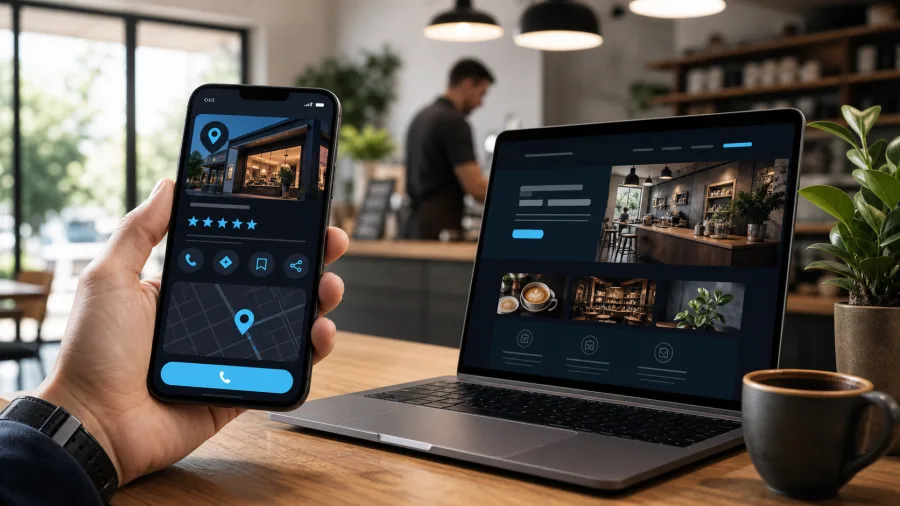
If you run a local business in the US or Canada, you probably do not have to pick between a Google Business Profile and a website. The useful question is how well the two work together. Your Google Business Profile catches people at the moment they search “near me”: it puts you on the map, shows your rating, and gives them a call button and directions in one tap. Your website is where they go next to find out whether you are the right choice.
Lean only on the profile and you get found, but everything about your business lives inside a platform you do not control. Lean only on the website and you may look polished while the people searching on their phones in the map results never see you. For a contractor, a clinic, a restaurant, a law or accounting office or a shop, the setup that holds up is plain: Google gets the first look, the website closes the decision.

Google Business Profile
- map pin and directions
- hours and phone number
- star rating and reviews
- tap-to-call from the results
- photos and posts

Your own website
- services, pricing, menu
- quote forms and booking
- FAQs, policies, service areas
- pages that can rank for searches
- analytics, and the site is yours
Why small business owners keep asking this
The profile is free, it takes an afternoon to fill in, and sometimes the first phone calls really do come from it rather than from the website. So the reasoning goes: Google already shows my hours, photos and reviews, why pay for a site on top of that?
Because the profile covers only the first part of the decision. A homeowner in Ohio with a dead furnace might pick three HVAC companies from the map and call the first one that answers. But someone choosing a dentist, a lawyer, a wedding caterer or a roofer for a big job wants more than a star rating. They want to see what you actually do, what a typical job costs, whether you cover their town, whether you are licensed, and what happens after they reach out. A profile has no room for that. A website does.
In practice, many people check the reviews on Google and then open the website, or search the business name on social media, before they commit. A strong profile often sends people to your site rather than replacing it. If the site is thin or out of date at that moment, you lose the person you just won.
What your Google Business Profile does best
The profile shines when the customer is in a hurry and searching close to home. Restaurants, clinics, salons, plumbers, auto shops, boutiques and mobile services get the most out of it.
A good profile answers the quick questions:
- where you are, or which areas you serve;
- whether you are open right now;
- how to get there;
- how to call you with one tap;
- what your overall rating is;
- what customers said recently;
- what the place, the work or the food looks like;
- whether they can book, message or order, if you have switched those features on.
Google describes local results as a mix of relevance, distance and prominence. Relevance is how well your listing fits the search. Distance is how far you are from the searcher or the place they typed. Prominence is how well known and trusted you appear online. A profile with the wrong category, stale hours and unanswered reviews does poorly on all three, while a complete, active one does better.
It also has real limits. The profile sits on Google’s platform. Google changes the interface and the rules, other users can suggest edits to your details, and a listing can be suspended or lose features while it is under review. Following Google Business Profile guidelines helps, for instance using your real business name rather than stuffing keywords into it, but it does not make the profile yours. It is a strong front door, not a foundation to build the whole business on.
What a website does that a profile cannot
A website should not just repeat the address and phone number that are already on Google. Its job is everything that does not fit in a listing.
On your own site you can properly lay out:
- each service in plain language, with prices or typical ranges;
- a restaurant menu as real text that reads well on a phone, not a giant PDF;
- a request form, an online booking tool, or a way to schedule a consultation;
- an FAQ that answers the questions you get every week;
- photos of finished work, case studies, and reviews with context;
- policies on payment, cancellations, warranties and delivery;
- separate pages for separate services, cities or campaigns;
- license numbers, certifications and the other details that show you are a real, established business.
Google’s own documentation encourages businesses to verify their site in Search Console and to give search engines clear information about who they are. Put simply, the website is where you explain what you do, where you work and how to reach you, and where Google can read it.

Relevance
Does your listing and your site match what the person typed? Your category, service pages, wording and FAQs all feed into this.
Distance
How near are you to the searcher? Your address or service area, and the pin on the map, answer this one.

Prominence
How established do you look? Reviews, mentions, links to your site and the quality of your content all play a part.
The biggest advantage of a website is control. You decide the structure, add pages whenever you want, measure which ones bring inquiries, connect analytics, add French alongside English if your customers need it, route inquiries into your inbox or a CRM, and send ad traffic to the exact page that fits the ad. On Google’s platform you get a fixed layout and a short list of fields.
How a customer actually decides
Few people decide at a single point. It is usually a short chain:
- They search for a service, or for something nearby.
- They see a handful of businesses in the results or on the map.
- They compare ratings, how recent the reviews are, photos and hours.
- They open one or two websites to understand the details.
- They look for prices, a menu, proof of work or a booking option.
- They go back and call, get directions, book or send a request.
So “which matters more” is the wrong frame. For a fast local pick, the profile carries more weight. For a confident decision, a bigger purchase or a service that needs explaining, the website does. They should lead the customer in the same direction rather than contradict each other.
Think of a restaurant whose Google listing sends people to a homepage where the menu is three taps deep inside a PDF. Some visitors simply back out. Think of a salon whose listing has a website button, but the site has no prices and no photos of the work. The visitor keeps comparing. Think of a roofing company with a spotless profile and a website that looks like 2012 and breaks on a phone. The trust the profile earned drains away on the next screen.
Where customers get lost
The most common problem is not having no site or no profile. It is having both, managed separately, telling slightly different stories.
Typical gaps:
- different hours on Google and on the website;
- holiday or storm-season hours posted on Instagram but missing from both;
- an old phone number still on the listing;
- the listing’s website link pointing to the homepage when it should point to the service or booking page;
- no street address or service area written out as text anywhere on the site;
- a menu or price list that only exists as a heavy PDF;
- a contact form that emails you but keeps no copy, so one lost email means one lost lead;
- reviews piling up on the profile with no replies;
- fresh photos on Google and old ones on the site;
- a site that is not connected to Google Search Console, so nobody sees technical problems.

Mismatched hours and contact details do the most damage. A customer who sees one number on Google, another on your site and a third in an old flyer will not stop to work out which is right. They call the competitor whose information is consistent. For a local business that is not an abstract SEO issue. It is missed calls and empty chairs.
A hypothetical example
Say a family restaurant in Texas closes early on a holiday weekend. The owner posts about it on social media, but nobody updates the website or the Google profile. The listing still says open until 10, so a couple drives across town, finds the lights off, and leaves a one-star review. Meanwhile, someone else wanted to reserve a table for six. The profile’s website link goes to the homepage, the booking page is buried, and they go back to the results and pick another restaurant.
Or say a dental practice in Ontario has a nice profile but the site shows an outdated list of insurance plans and an old front-desk number. New patients call, get a disconnected line, and move on.
In cases like these, the fix is often not a new website. It is putting the existing pieces in order:
- update hours on both Google and the website;
- review holiday dates and seasonal changes in advance;
- point the profile’s link straight to the menu, booking page or relevant service page;
- remove the outdated PDF and replace it with a page;
- add a clear call or booking button on the mobile version;
- make sure form submissions are saved, not just emailed;
- add a tracking tag to the profile link so you can see its visits in analytics;
- check Search Console for critical errors.
This is less exciting than a redesign, but it is frequently what moves revenue. Customers do not care about design debates. They want to know quickly whether you are open, what you offer, what it costs, whether they can trust you and how to take the next step.
Can you run on a profile alone?
Sometimes starting with only a Google Business Profile makes sense: a brand-new business, a very simple service, all inquiries by phone, no budget yet for a site, and an owner who will actually keep the profile current. That is far better than having no local presence.
It is a stopgap, though, not a plan. The limits are real:
- complex services are hard to explain in a listing;
- you cannot build pages for different searches;
- you have almost no control over layout or structure;
- it is harder to track where customers come from;
- you cannot grow your own content library;
- your business depends on the rules of one platform.
For a simple start, a profile is enough. For a business that wants steady inquiries, advertising, bilingual service in Canada or a more established look, it is not.
When a website becomes essential
The more questions a customer has before buying, the less a listing can do alone. You are close to needing a real site when:
- you run a restaurant, café or delivery business with a menu, reservations and seasonal specials;
- you are a salon, shop or trade where photos of past work and pricing matter;
- you offer several distinct services, such as repair, installation and maintenance;
- customers need to describe a job, attach a photo or pick a service before you can quote;
- you serve people who prefer English or French, or other languages;
- you buy ads and need a landing page that is not the homepage;
- you want to know which pages actually produce inquiries;
- you want to show up in searches for your services, not just your business name.
At that point the site stops being a business card you feel you should have. It explains, answers repeat questions, takes requests, backs up your ads and builds trust.
A 30-minute check you can do yourself
You do not need a full audit to start. Open your Google profile and your website the way a customer would, on your phone.
Look at:
- whether the business name is the same in both places;
- whether the address, phone number and hours match;
- whether holiday and seasonal hours are current;
- whether the profile’s website link lands on the right page;
- whether you can find the menu, prices, booking or form within one or two taps;
- whether the site reads well on a small screen;
- whether there is one obvious action button;
- whether you have replied to recent reviews;
- whether the photos on Google are recent;
- whether a form submission is stored on the site if the email never shows up;
- whether Search Console and basic analytics are connected;
- whether you can tell which visits came from your Google profile.
If you find two or three obvious problems, fix those first. There is no need to rebuild everything. Often the best return comes from removing friction: the right link, correct hours, a form that works, a readable menu, a fast mobile page.
When to get help with this
It makes sense to bring someone in not when you vaguely feel you should “do more online,” but when the pieces need to work as one system and you would rather not spend your evenings on it. I work with small businesses across the United States and Canada, and these are the situations where I can help:
- your profile is complete but the website does not turn visits into inquiries;
- the website exists, yet hardly anyone arrives from the profile;
- your details differ from one place to the next;
- you need a menu, booking tool, quote form or service page built;
- you want inquiries stored safely instead of depending on email alone;
- you need pages in English and French, or another language;
- you want analytics, link tagging and Search Console set up with clear goals;
- you want local business structured data added to the site;
- you need a quick read on what is stopping people from calling or booking.
The point is not to add another channel. It is to stop customers from bouncing between conflicting versions of the same information, so they find you on Google, land on the site, get their answers and act.
Frequently asked questions
Do I need a website if my Google Business Profile already gets calls?
If the calls are steady and your service is simple, you may be fine for a while. But the profile cannot show detailed pricing, past work or policies, and it belongs to Google. A basic site gives you something you own and a place to send ad traffic.
Which should I fix first, the profile or the website?
Start with whichever one shows wrong information. Wrong hours or a dead phone number cost you customers right away, wherever they appear.
Does this apply to service-area businesses with no storefront?
Yes. A plumber, cleaner or mobile groomer can show a service area instead of a public address. The website then matters even more, because it is where you list the cities you cover and the jobs you take.
I serve customers in English and French in Canada. What should I do?
Keep the profile accurate in both languages where you can, and give the website separate English and French pages rather than mixing both on one page. Check what language rules apply to your province and business. I am not a lawyer.